


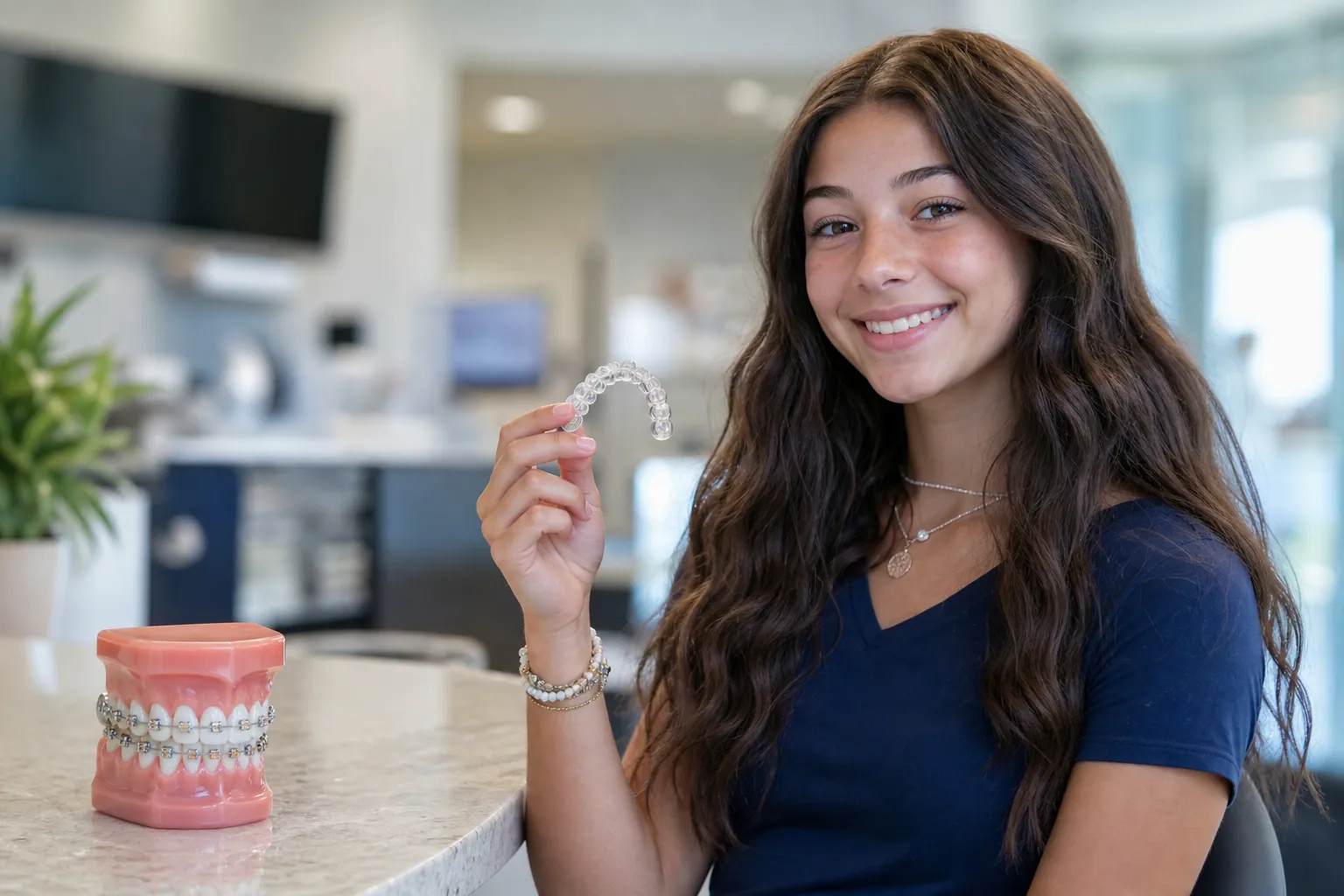
If you're weighing braces against clear aligners — for yourself or your teenager — start with the good news: both work. Modern orthodontics gets excellent results either way, so the real question isn't which technology is better. It's which one fits your bite, your budget, and, honestly, your discipline.
Here's the side-by-side most people wish they'd seen before their first consultation: realistic 2026 price ranges, actual treatment timelines, and the day-to-day tradeoffs that matter more than the marketing.
National ranges for US patients in 2026 look like this. Your quote will vary with case complexity and geography — expect big-city practices to land at the higher end.
Dental insurance with an orthodontic rider typically pays a lifetime benefit of $1,000 to $3,000, and it usually applies equally to braces and aligners. FSA and HSA dollars work for both, and most practices offer monthly payment plans with little or no interest. Ask specifically what the quote includes — refinement trays, retainers, and replacement aligners (often $100 to $200 apiece if one goes missing) can be inside or outside the number.
For mild to moderate crowding or spacing, aligners often finish in 12 to 18 months, while braces average 18 to 24. On complex cases, both can stretch to 24 to 36 months — and braces frequently get there faster, because the orthodontist controls tooth movement directly instead of depending on how faithfully you wear trays.
One underrated aligner perk: fewer office visits. Many aligner patients check in every 8 to 12 weeks, versus adjustment appointments every 4 to 6 weeks with braces. If you're juggling work meetings or school pickup, that difference adds up over two years.
Braces win no points for comfort in the first week: brackets can irritate cheeks and lips, and each adjustment brings a few days of soreness. You also inherit a real list of off-limits foods, because a broken bracket means an extra visit and a longer timeline.
Aligners are gentler — mostly a day or two of pressure when you switch trays, plus a mild lisp the first week. Because they come out for meals, nothing is off the menu. The tradeoff: you need to brush before the trays go back in, which turns every coffee and snack into a small project.
Aligners only straighten teeth while they're on your teeth — and that means 20 to 22 hours a day, every day. Skimp on wear time and the trays stop fitting, treatment stalls, and you're paying for refinements or a restart. Braces don't ask for willpower; they're bonded on and working around the clock.
This is usually the deciding factor for teens. Some 14-year-olds are meticulous; plenty are not. If you already suspect the trays will spend afternoons in a backpack, braces are the safer investment.
As a rule of thumb, here's where each option is strongest.
The catch is that you can't reliably self-sort your own case. Digital scans and X-rays regularly reveal root positions or bite problems that flip the answer, which is why the diagnosis and treatment plan belong with a licensed professional — an orthodontist or a practice like Acme Dental — not a mail-order impression kit.
Pick braces if your case is complex, price is the hard constraint, or compliance is doubtful. Pick aligners if your case is mild to moderate, you value discretion and food freedom, and you'll genuinely wear them 22 hours a day.
Whichever you choose, budget for retainers afterward — roughly $150 to $500 per set — because teeth drift back without them. Straightening is the project; the retainer is the warranty.